A First Visit to a Public Commemoration: What to Notice
A first visit to a public commemoration can feel hard to read. Notice its sequence, objects, language and practical arrangements to understand the event.
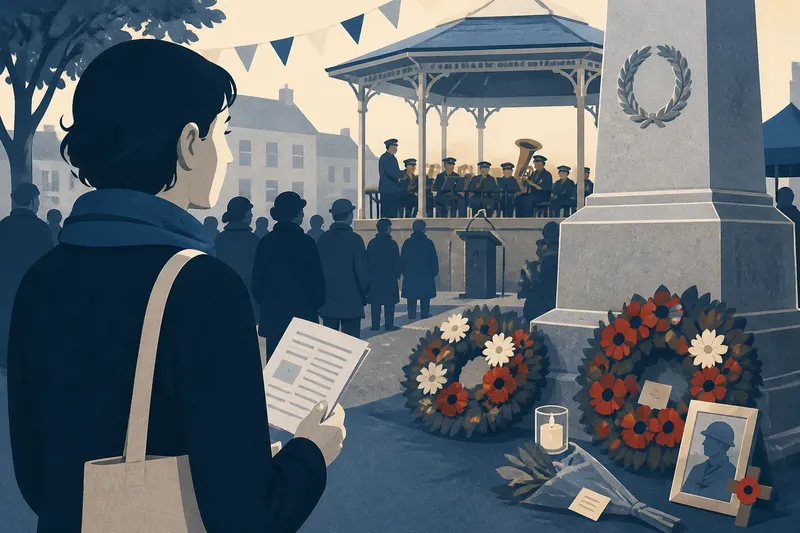
You arrive at the town square as a brass band finishes tuning. A programme is folded in your pocket, and the memorial is partly hidden by a temporary stage. A first visit to a public commemoration can feel hard to read, but attention to its sequence, objects, language and practical arrangements gives you a clearer account of what is happening.
The aim is not to decode a gathering into one official meaning. A commemoration is made by choices: what gets named, which objects are displayed, how the programme is ordered and what the organisers leave unexplained. Those choices can be observed without treating them as a secret code.
Public commemoration sequence
A commemoration may begin with music, a procession, a silence, a welcome or an announcement. Order affects emphasis. A pause before a speech can frame it differently from a pause after a list of names; a wreath placed at the end may give the closing words a visible focus.
Programmes are useful, but they are maps rather than contracts. A printed order may omit a short introduction, or a speaker may wait while equipment is adjusted. Watch for transitions: a person approaching the lectern, a change in music, or an object being carried to the memorial. These details tell you what follows, not necessarily why it was chosen.
Imagine you arrive at a neighbourhood memorial while a speaker is silent and a wreath-bearer is waiting. The programme lists a reading before the wreath is placed. You stay where you are, notice that the speaker returns to the lectern after the wreath is laid, and understand that the pause was part of the sequence rather than an unexplained interruption. You still do not know what the moment means to each person present.
Record the order of events before interpreting it.
Objects and public memory
Flags, plaques, photographs, candles and wreaths make public memory visible. Their prominence does not settle their meaning. A wreath might represent an organisation’s presence, a gesture of mourning or a formal duty. A plaque may name some people while leaving other experiences outside its frame.
Start with observable details. Who brings an object? Where is it placed? Is it named in a speech, or left without explanation? Is it part of the planned programme, or has someone added it independently? These questions help describe how an object functions in the event without claiming to know what every observer feels.
Look for what shares the space with the main monument: a handwritten card, a temporary display or an open area where people can leave flowers. These details may broaden what is visible, though they do not by themselves explain the history behind the gathering. If a plaque or programme gives context, note its wording and who produced it.
Describe what an object does before deciding what it represents.
Language and civic memory
Words such as service, sacrifice, loss, duty and hope recur in commemorative speech. Familiar language can give an event a recognisable form, but it can also smooth over differences in experience. Listen for the people and actions named: who speaks, who is spoken about, and who appears only as part of a broad group?
A reading, a list of names, a prayer and an official address are distinct forms of speech, even when all are delivered solemnly. A programme may identify the speaker’s role or name a text. If it does not, keep your account specific: a phrase was repeated, a list was read, or a group was addressed. A confident guess about the speaker’s intention is less useful than an accurate description.
Notice who appears in the words, not just the tone in which they are delivered.
What can a first-time visitor tell?
What should I note first?
Start with the order of events, the objects in view and the words used by speakers. Those observations give you a reliable account of the occasion without requiring you to infer private feelings.
How can I check a detail?
Look at the programme, the memorial’s inscription or the event organiser’s public information. If the detail remains unclear, ask an organiser at a suitable moment and distinguish their explanation from a complete account of the community.
How do I avoid over-interpreting a gesture?
Write down what happened before assigning a motive: for example, “a wreath was placed after the reading”. Treat claims about what the organisers intended as interpretations that need additional context.
What if the event is difficult to hear or see?
Move to a clearer spot if that is possible, check the programme, or ask an organiser for a basic explanation. If you arrive late, describe the part you witnessed rather than filling gaps with guesses.
These questions are about reading the event’s public form, not deciding what its participants ought to feel. Keep a simple record with two columns: “observed” and “inferred”. If the observed column says “a list of names was read”, an inference such as “everyone present shared the same memory” belongs elsewhere and needs more evidence.
Practical details and interpretation
Weather, loudspeakers, blocked sightlines and late starts can make a commemoration harder to follow. A quiet crowd does not automatically signal disapproval; a missed cue does not automatically carry symbolic meaning. Sometimes a loudspeaker is simply pointed towards the bandstand rather than the pavement.
Use the information available before drawing conclusions. Check whether a programme lists the next item, move somewhere you can hear, or ask a steward what is scheduled. If the order changes, note the change rather than assuming that the event has failed.
Here is a practical way to keep observations separate from guesses:
- If the programme lists an item and it begins as printed, record the item and its place in the order; if it does not, note the change and avoid inferring the reason.
- If a speaker names the person or group represented by an object, record those words; if nobody explains it, describe the object’s placement without assigning a meaning.
- If an inscription names particular people, note whom it names; if the event refers to a wider group, check the programme or organiser’s information before treating the two as identical.
- If a microphone makes speech difficult to hear, move to a clearer spot or ask an organiser; if neither option works, mark the speech as partly inaudible rather than completing it from context.
- If a temporary display sits beside the memorial, note who appears to have placed it only when that is clear; if not, record its position and avoid guessing who made it.
- If the organiser gives an explanation, attribute it to that source; if another participant offers a different account, keep both views distinct rather than forcing a single version.
These checks do not produce a definitive account of the community’s memory. They make it easier to say what the event showed, what its organisers said and where uncertainty remains.
Evidence and interpretation
A first visit offers a view of one occasion, not a complete history. Separate what you saw, what you heard and what you inferred. “A wreath was placed after the reading” is an observation. “The organisers intended to settle a dispute” is an interpretation that calls for more context.
If you want to learn more, consult the memorial’s wording, the public programme or information from the organisation responsible for the event. A conversation can add a useful perspective, but one person’s account should not be presented as the whole community’s view. For a first visit to a public commemoration, the most useful record is often a modest one: what happened, what was named, and what remains uncertain.
Keep the programme or make a note of its organiser’s name. It gives you a concrete starting point if you later want to check how the event describes its own history.