Ritual or Ceremony: What Changes When an Audience Takes Part?
Ritual or ceremony: understand how witnesses alter a repeated act, and how organisers can make its public meaning clear without prescribing a response.
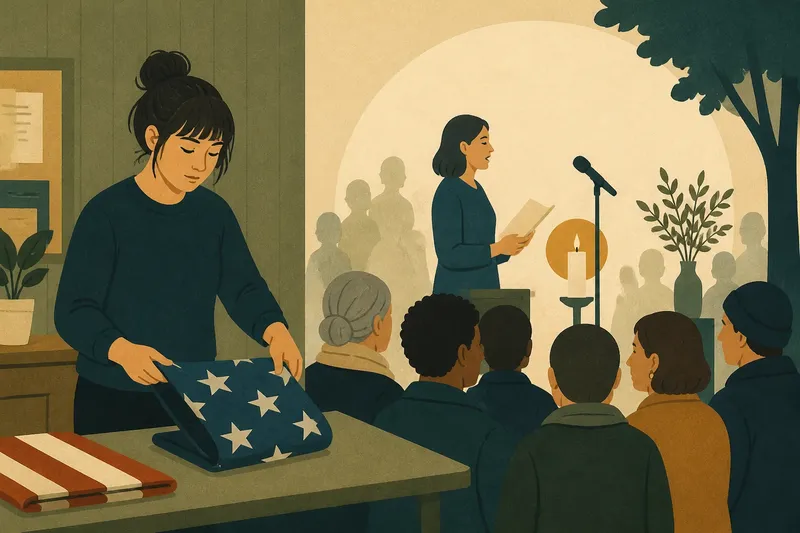
At a community hall, someone folds a flag after a meeting while a singer performs the same movement before a formal gathering. The gesture may look alike, but the setting changes what it communicates. Ritual or ceremony turns on more than whether an act is private or public: repetition, framing and responsibility all matter.
Ritual and ceremony
A ritual is a patterned action given meaning through repetition. A ceremony is an arranged occasion in which actions are presented for others to witness, join or acknowledge. The terms overlap: a ceremony may contain rituals, and a personal ritual may be performed in front of others.
Lighting a candle before leaving home can be a private ritual. Lighting one at a civic gathering, within an announced sequence, can become a ceremonial act. The candle has not changed; the setting, recognised order and attention of others have.
Publicness comes in degrees. A family meal may include a formal toast without becoming a civic ceremony. A town meeting may acquire ceremonial features through a repeated opening, a shared pause or a familiar song. Ask what the action asks people to recognise or do.
Witnesses and meaning
An audience makes an action observable and, often, answerable. Someone can repeat a private gesture for personal reasons without explaining it. Before witnesses, that gesture may signal respect, welcome, mourning or allegiance. People can interpret it differently, but its public meaning is no longer held by one person alone.
A few neighbours watching the opening of a shared garden may give the moment a public character if they recognise it as a common undertaking. A packed room, by contrast, can remain an audience in the narrow sense: people watch a performance without being invited into its action.
Public ceremonies can offer different roles: witnessing, speaking, moving or taking responsibility for part of a sequence. They need not require everyone to perform the same act. An invitation should also make clear whether people may decline, so that attendance is not mistaken for consent.
State plainly what people are invited to do and what they may leave aside.
Repetition and change
Repetition lets people recognise an event without hearing every detail explained again. A familiar opening phrase, pause or order of speakers can signal the kind of attention expected. Participants share a reference point even when their personal meanings differ.
Repetition also makes changes noticeable. If a community usually begins a gathering with silence, a different opening may prompt questions about why the occasion has changed. Tradition need not be a fixed script, but changing a familiar action is a public choice. People may reasonably ask who made it and what it expresses.
A repeated gesture can become mere recitation. If people are expected to say words they do not understand or mimic an action without knowing its place, the pattern can feel like a test of belonging. A short explanation can help; an exhaustive account of every symbol can bury the moment.
Shared attention
A ceremony gives a group a temporary point of focus. People might look towards a speaker, face a memorial, listen as a name is read or observe a pause. They need not share an interpretation; they are attending at the same time within an agreed public frame.
This differs from simply assembling in one place. A crowd waiting for a bus occupies space together; a group listening as a name is read has been invited to treat that moment as significant. Yet a ceremony cannot dictate private feeling, and visible participation does not prove that everyone feels the same way.
Practical arrangements affect who can follow the action. A microphone that cannot be heard, an unclear sequence or instructions given only to some people can leave others outside it. Make cues audible and describe them plainly. Accessibility shapes participation rather than decorating it.
From private to public
A private ritual can become a public ceremony when it is adapted for witnesses and placed within a shared occasion. The change might involve a spoken invitation, a recognised sequence or a role for others; the original personal meaning need not disappear.
Say a resident privately writes a note of remembrance each year. At a neighbourhood gathering, organisers invite others to write notes and place them in a common box. The steps are to introduce the practice, offer paper and pens, invite contributions without requiring them, then place the notes together. The observable result is a shared collection rather than a private one; the trade-off is that personal words now sit within a public setting. No one has to disclose anything, and the invitation should not suggest otherwise.
Public framing can also alter an act in ways its original participant did not intend. Organisers should consider who introduces it, who may join and whether the practice is represented fairly. Where a practice carries meanings outsiders may not know, seek guidance from people who understand it and ask permission where appropriate.
Planning a ceremony?
Who is invited?
Identify who the event addresses and who may feel it speaks about them without speaking with them. If affected groups are missing from the planning, then invite their input; if they prefer not to participate, then do not present their absence as approval.
What roles are clear?
List the available roles, such as watching, listening, speaking or contributing an object. If the programme explains each role, then people can choose knowingly; if it assumes everyone will join in, then rewrite the invitation to include a genuine alternative.
Which actions repeat?
Identify recurring words or gestures and explain significant changes. If a repeated action remains meaningful and understood, then keep it; if it has become an unexplained cue, then clarify its purpose or reconsider its place.
How can people decline?
Provide a quiet way to remain present without joining a particular action. If an alternative can be offered without singling anyone out, then include it; if participation would imply a belief or allegiance, then make witnessing alone an explicit option.
After the occasion
Once a gathering ends, people may remember different things: words spoken, an action they joined or a choice not to join. Organisers can acknowledge those differences without claiming the event produced one shared interpretation.
A useful sign of a well-framed ceremony is that people can describe what happened and how they could take part. In ritual or ceremony, that clarity matters more than a uniform response: the public act can be shared without requiring everyone to mean exactly the same thing.